The Infostealer Pandemic II : Why Everyone is Target
This article is based on an extensive analysis of infostealer leaks from 2024 and 2025, specifically examining data from 112 companies that are either Portuguese or have active operations in Portugal. It also presents critical, multi-layered defence strategies necessary for organizations to withstand the increasing threat of credential theft.
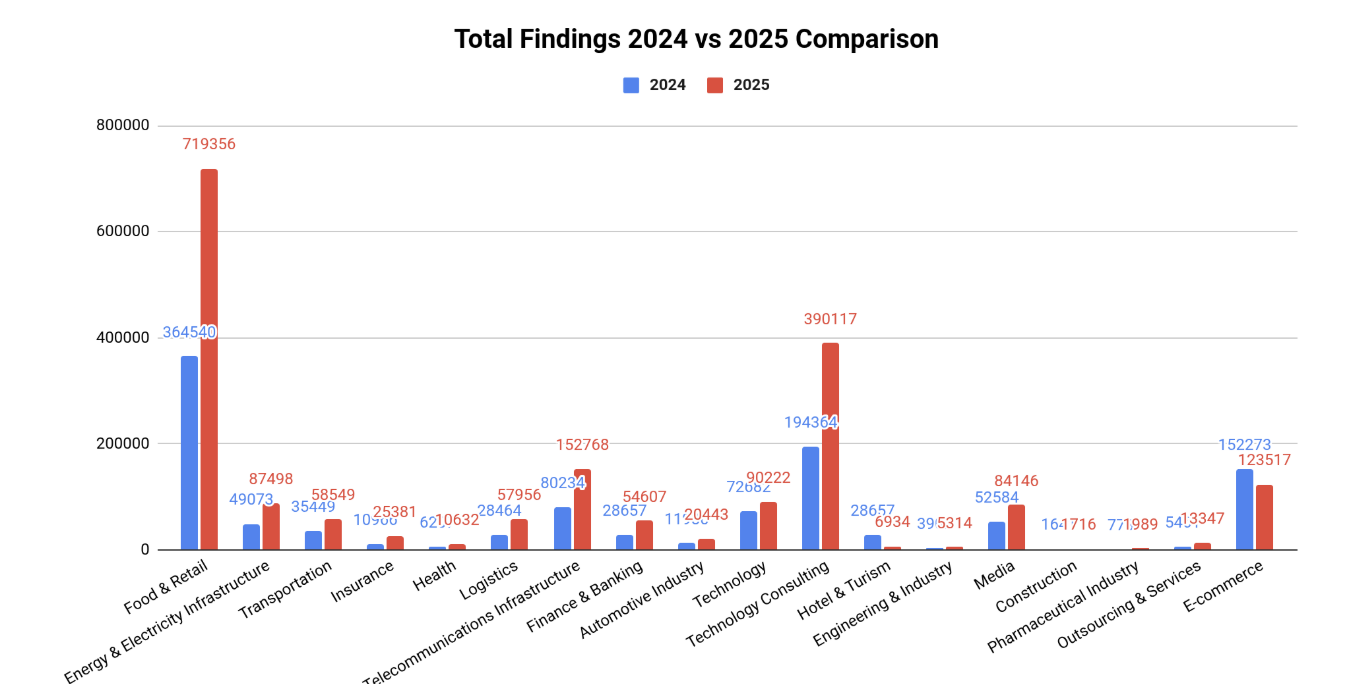
An analysis of the “Total Findings 2024 vs 2025 Comparison” metric reveals an alarming intensification of the current threat environment.
Crucially, Total Findings tracks the cumulative volume of harvested data points, a figure that naturally encompasses significant duplication. Since these tools operate relentlessly and stolen artifacts are perpetually recycled within the underground economy, a single set of credentials often resurfaces across numerous logs. As such, this metric serves as a vital barometer for the scale and persistence of the ecosystem, demonstrating that compromised data is not a localized incident but a recurring, systemic risk that maintains its toxicity over time.
The trajectories visualised in the “Total Findings 2024 vs 2025 Comparison” underscore a profound acceleration in cybercriminal output. Across nearly all analysed sectors, the aggregate volume of exfiltrated assets including session cookies, authentication pairs, and Personally Identifiable Information (PII) has effectively doubled, with some industries seeing a threefold surge in exposure. This data confirms that infostealers have transitioned into the foundational infrastructure for industrial-scale data harvesting. This expansion provides a relentless stream of “live” entry points for threat actors, drastically shortening the interval between initial device compromise and the deployment of destructive secondary attacks.
This is the second-part of the of the Infostealers Series.
Read the first part: The Infostealer Pandemic: Why Every Organisation Is Vulnerable
The Massive Spike in Food & Retail
The most alarming trend in the data is the Food & Retail sector. In 2024, findings were already high at 364,540, but by 2025, that number skyrocketed to 719,356.
Why Food & Retail? This sector is a goldmine for MaaS operators. High volumes of consumer credit card data, loyalty programme logins, and a heavy reliance on third-party delivery apps make it an easy target.
As seen in recent trends, these leaks don’t just result in stolen accounts, they can disrupt entire supply chains. When a major distributor’s credentials are leaked via an infostealer, the resulting ransomware attack can literally empty grocery store shelves.
The Escalating Threat in Technology Consulting
Another sector witnessing a dramatic escalation is Technology Consulting. While always a target, the volume of findings in 2025 has surged, reflecting a strategic shift by threat actors who view these firms as essential gateways.
- The Gateway Effect: Compromising one consultant often provides simultaneous access to the users and internal networks of dozens of downstream client organizations.
- Premium Assets: These logs are rich in “premium” credentials, such as AWS and Azure administrative API keys, cloud deployment pipeline access, and session tokens.
- Beyond Data Theft: Attackers leverage these credentials to impersonate legitimate IT employees. By hijacking deployment pipelines, they can inject malicious code directly into the environments of multiple client organizations, effectively outsourcing their lateral movement to the consultant’s own trusted access.
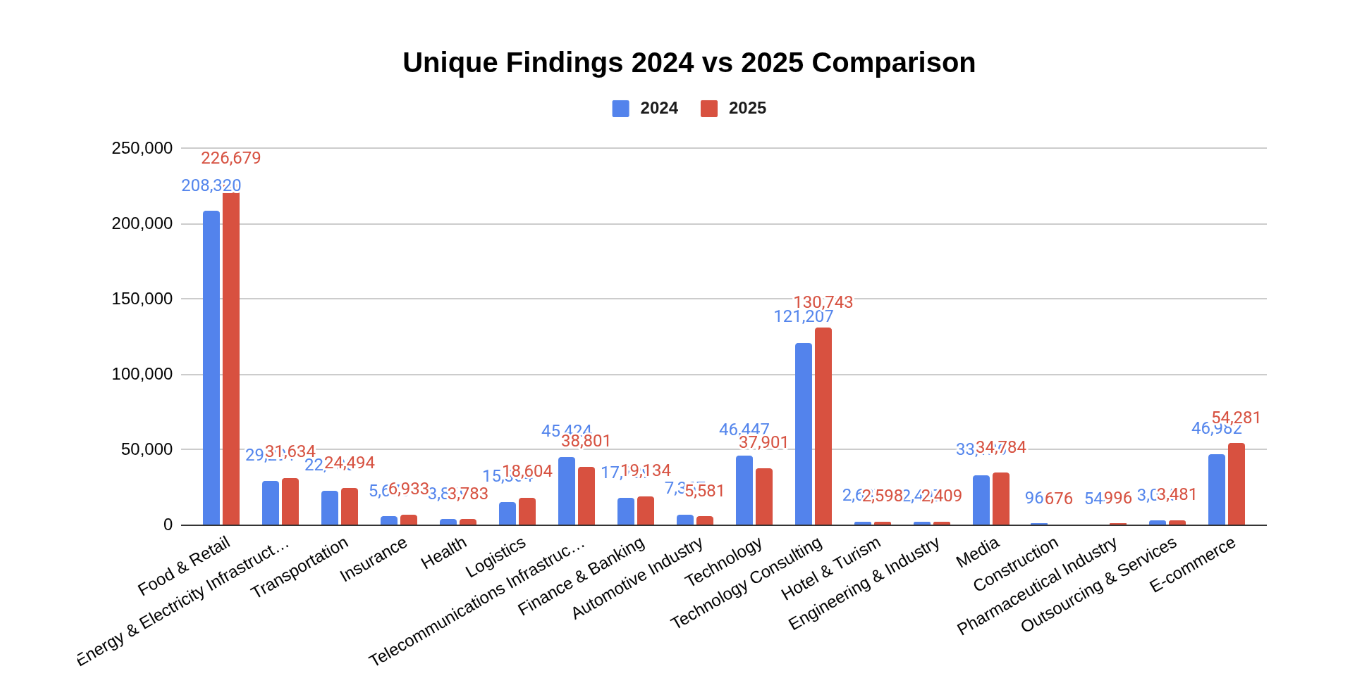
To effectively evaluate the threat landscape, we must distinguish between aggregate volume and actual severity. The “Unique Finding 2024 vs 2025 Comparison” metric isolates distinct data points, surgically removing the “ecosystem noise” of duplicate log entries. This provides a more accurate barometer of individual risk, filtering out recycled artifacts to reveal the true breadth of sensitive asset exfiltration. By focusing on unique identities and credentials, this view exposes the genuine impact of the infostealer pandemic on individual accounts within the underground economy.
The Masking Effect: Why Total Findings Can Be Deceptive
Analysis of the 2024–2025 telemetry reveals a dangerous paradox within the E-commerce sector. While the Total Findings metric often inflated by duplicate logs indicated a deceptive 18.9% decline, the volume of Unique Findings actually surged by 15.5%. This discrepancy underscores a critical shift, even as “noise” decreases, the harvest of fresh, high-value credentials continues to accelerate. For security leaders, these unique findings represent the true, expanding attack surface, confirming that a decrease in aggregate volume can mask a significant rise in individual exposure.
The Impact of Duplication: Volume vs. Severity
It is critical to distinguish between metrics when evaluating infostealer impact:
- Total Findings (Volume): Measures the aggregate scale and persistence of the infostealer ecosystem. It is an excellent indicator of ‘ecosystem noise’—how often data is being resold or re-harvested.
- Unique Findings (Severity): Filters out duplicate entries to show the volume of distinct identities, credentials, and sensitive assets exposed. This metric provides a more accurate view of individual risk and the true breadth of data exfiltration.
Sector-Specific Risk Profiles
A comparative analysis of unique findings between 2024 and 2025 highlights clear strategic pivots in attacker behaviour:
- High-Volume Escalation: The Food & Retail industry remains the primary battleground, with distinct data points climbing from approximately 208,320 to 226,679 within a single year.
- Emerging Threats: The Pharmaceutical Industry witnessed a staggering 80% surge in exposure (rising from 544 to 996), signaling an aggressive pursuit of proprietary IP and sensitive supply chain intelligence.
- Strategic Hubs: The Technology Consulting sector continues to show massive unique exposure, totaling 130,743 findings in 2025. This underscores the persistent “gateway” risk, where service providers are exploited to compromise multiple downstream client environments.
This telemetry confirms a widespread escalation in credential vulnerability across the board, even after stripping away redundant log data. This reality is most striking in the e-commerce sector, while aggregate metrics might suggest a decline, the unique findings reveal a continuous influx of compromised assets. For security leaders, this proves that aggregate volume can mask the true severity of the threat, making the isolation of unique, fresh credentials essential for an accurate risk assessment.
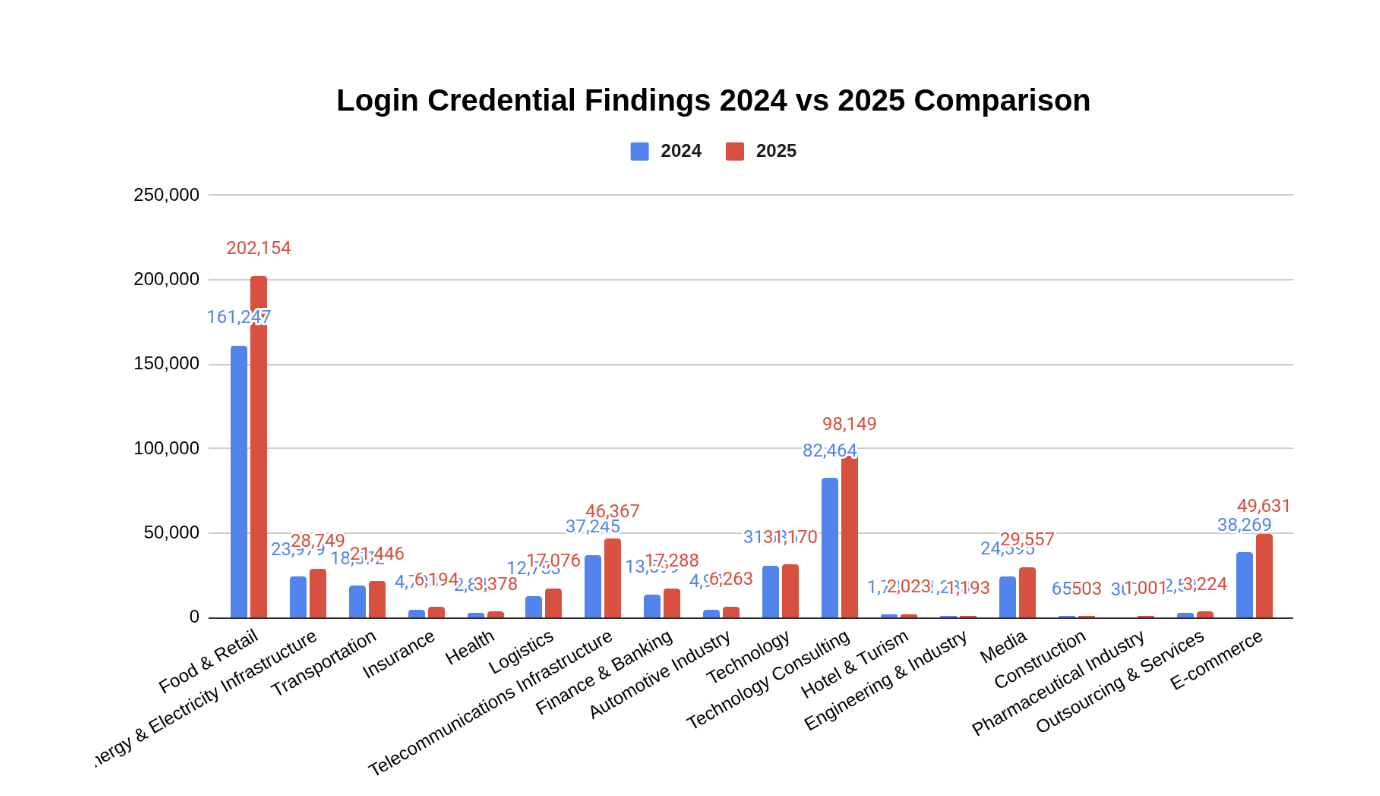
The “Login Credentials Findings 2024 vs 2025 Comparison” telemetry provides a surgical focus on captured authentication pairs harvested via infostealer logs. While other metrics may include general system noise or file dumps, this specific view isolates the most critical assets for unauthorized access, the usernames and passwords that serve as the keys to both corporate and personal environments.
This data confirms a relentless escalation across all analysed sectors, underscoring the systemic nature of the pandemic within the Portuguese corporate landscape. The surge in these findings proves that threat actors have professionalized the exfiltration of authentication data, effectively converting stolen logs into pre-packaged initial access points designed to neutralise traditional defensive perimeters.
A unique strategic shift is visible in the e-commerce sector, which shows a surprising divergence from the broader trend. Despite the explosion of online retail activity, credential capture in this space remains suppressed relative to the massive surges seen in Technology Consulting. This discrepancy likely reflects the impact of third-party payment gateways and hardened identity controls, such as real-time device fingerprinting. These defensive layers may be successfully devaluing stolen assets, forcing attackers to pivot their attention toward more vulnerable targets across the broader supply chain.
The 48-Hour Lifecycle: Translating Credentials into Breaches
The surge in login credentials shown in this graph is not merely an increase in stolen data, it represents a direct expansion of the “initial access” pipeline for ransomware operators. Current telemetry confirms that the window from credential theft to ransomware deployment is now often under 48 hours.
This urgency is compounded by the “gateway” effect observed in sectors like Technology Consulting, which saw 98,149 compromised credentials in 2025 alone. When these credentials are used to hijack administrative pipelines, attackers don’t just gain access they gain the keys to multiple downstream environments simultaneously. Similarly, the Pharmaceutical Industry experienced a dramatic spike, with credential findings jumping from 307 to 1,001, a nearly 226% increase marking a clear strategic focus on high value intellectual property.
For security teams, these credentials represent the point of no return. While system information provides reconnaissance, login credentials represent the conversion from observation to full network access. Every hour that stolen credentials remain active in the wild is an hour closer to a full-scale network compromise.
Recommendations
A Multi-Layered Defence Against Infostealers
Protecting an organization from infostealer attacks requires a shift from perimeter defence to an assumed-breach mindset, focusing on both prevention and mitigation. The following multi-layered strategy addresses the attack across the entire cyber kill chain:
1. Preventing Initial Infection (Employee Device Security)
The ultimate objective is to neutralise the execution of infostealer payloads at the source, shielding both managed corporate endpoints and personal devices (BYOD) from initial compromise.
| Defence Layer | Key Actions | Strategic Rationale |
|---|---|---|
| Endpoint Detection and Response (EDR) | Provision sophisticated EDR agents across the entire fleet, including mandated BYOD hardware. Maintain persistent telemetry to facilitate the rapid quarantine of anomalous processes. | EDR serves as the frontline barrier. Its capacity to intercept fileless techniques and disrupt C2 beacons is fundamental to survival. |
| Proactive Patch Management | Orchestrate a rigorous, automated cadence for deploying security updates to operating systems and all third-party software stacks. | Exploit frameworks weaponize unpatched flaws to deliver payloads. Aggressive patching effectively dismantles these primary infection vectors. |
| Application Whitelisting | Enforce strict execution controls, permitting only digitally signed and pre-validated binaries to run within the environment. | This minimises the attack surface; as unauthorized tools, infostealers are prevented from launching their core routines. |
| Phishing Resistance Training | Deliver recurring, high-impact simulations focused on identifying AI-generated lures, malicious attachments, and deceptive update prompts. | Because employees are targeted specifically, continuous education transforms them into a resilient human firewall against social engineering. |
| BYOD Session Controls | For unmanaged hardware, enforce “view-only” restrictions or mandate the use of physical hardware security keys for every authentication event. | Where device management is impossible, session governance is paramount. Eliminate persistent tokens on untrusted endpoints to prevent hijacking. |
2. Mitigating Post-Infection Impact (Credential Hardening)
Should an infection occur, organizations can severely limit the resulting fallout by hardening authentication assets, making exfiltrated data virtually useless to the attacker.
| Defence Layer | Key Actions | Strategic Rationale |
|---|---|---|
| Phishing-Resistant Auth (FIDO2) | Migrate all enterprise services, remote access portals, and cloud infrastructure to FIDO2/Passkey-based authentication. | This eliminates shared secrets entirely, ensuring that stolen logs contain no actionable data for the threat actor. |
| Enterprise Secret Vaulting | Prohibit the use of native browser password managers. Deploy professional-grade vaults protected by robust, non-reused master credentials. | Infostealers are optimized for browser stores. Dedicated vaults provide superior encryption and defence against automated harvesting tools. |
| Least Privilege (PoLP) | Enforce granular access controls for all identities, ensuring that permissions are restricted to the absolute minimum required for business operations. | By constraining user scope, a single compromised credential cannot be weaponized to facilitate broad lateral movement or massive data theft. |
| Dynamic Credential Rotation | Establish policies for the frequent rotation of authentication pairs, with heightened frequency for privileged administrative identities. | Regular resets ensure that stolen credentials lose toxicity rapidly, closing the window of opportunity for secondary exploitation. |
3. Rapid Detection and Response (Breach Triage)
Following exfiltration, the priority shifts to ultra-fast detection to intercept the use of stolen assets before they mature into a full-scale network breach.
| Defence Layer | Key Actions | Strategic Rationale |
|---|---|---|
| Dark Web Telemetry | Actively scout underground marketplaces and infostealer repositories for exposed corporate domains, administrative emails, and employee logs. | Detecting leaks early facilitates immediate triage, allowing for account lockouts before threat actors can activate the initial access phase. |
| Behavioural Analytics (UEBA) | Utilise User and Entity Behaviour Analytics to flag anomalous login activity, such as geographic shifts or impossible travel trajectories. | Stolen assets often surface from malicious IPs. UEBA flags these deviations instantly, enabling real-time response to credential abuse. |
| Network Segmentation | Partition the corporate infrastructure to isolate high-value assets and limit the blast radius of a successful initial login. | Effective segmentation prevents lateral movement, ensuring that a localized compromise does not escalate into a systemic network takeover. |
| Continuous Access Evaluation | Implement logic to automatically revoke session tokens if a device’s security posture changes or suspicious telemetry is detected. | Do not rely on static login checks. Any shift in device health must trigger an immediate session termination to neutralise active hijackers. |