From Detection to Measurable Risk Reduction: A Strategic Approach to Vulnerability Management
The Growing Challenge of Alert Noise
Today, organisations rely on an increasingly vast and intricate network of systems, applications, and cloud services. As these technological environments expand – with new servers spinning up, cloud applications being deployed, and complex interconnected maps forming – the attack surface grows in tandem, revealing new vulnerabilities and a fault in vulnerability management.
When security systems generate hundreds or even thousands of weekly detections, simply finding vulnerabilities is no longer the primary challenge. The true hurdle is strategic: cutting through the continuous noise to understand which threats are genuinely critical, where to allocate limited resources, and, above all, guaranteeing that the most significant risks are actually resolved.
The objective of modern security must shift: it is no longer about finding more issues; it is about resolving the right ones. To achieve this, organisations must move away from treating vulnerability management as a reactive chore and instead build a structured, continuous, and highly risk-focused process.
The Ideal Paradigm: A Continuous, Five-Phase Cycle
Effective vulnerability management cannot be a point-in-time snapshot. It must operate as a continuous cycle, adapting month after month as the technological infrastructure evolves. This ensures that as new fragilities emerge, they are systematically captured, prioritised, and addressed, guaranteeing that organisational risk decreases over time.
A mature, high-functioning Vulnerability Management programme should encompass five critical, interconnected phases:
Phase 1. Asset Discovery & Comprehensive Visibility

Asset discovery in vulnerability management is the continuous process of mapping, cataloging, and evaluating all physical, virtual, and cloud assets across an enterprise. The process must always begin by defining the exact scope and systematically identifying all relevant assets within the environment. This phase is fundamental: you cannot protect what you do not know exists. By performing deep discovery and systematic evaluations, organisations identify weaknesses across the infrastructure, consolidating results into a comprehensive, centralised view of exposure. However, a high volume of raw detections does not, on its own, define an actionable remediation strategy.
Phase 2. Risk-Based Strategic Prioritisation
This is where true security engineering makes a quantifiable difference. Instead of treating every vulnerability equally or relying solely on a raw list of detections, a mature program applies context. Security teams must analyse key factors to filter and prioritise:
We ignore the brute force approach. Instead, we apply context. We filter and reorganise the extensive list of detections by analysing critical factors:
- Vulnerability Severity: The technical potential for harm (CVSS, among others.).
- Asset Criticality: The business importance of the affected system.
- Exposure Level: Is the system public-facing or deeply segmented?
- Exploitation Probability: Are there active exploits ‘in the wild’ for this flaw?
- Other factors.
This context-aware analysis transforms an extensive list of detections into a concise set of priority actions, allowing operational teams to focus on situations representing the greatest and most immediate risk.
Phase 3. Transforming Priorities into Actionable Projects
Once priorities are established, they must be made actionable. Priority vulnerabilities should be structured into dedicated Remediation Projects.
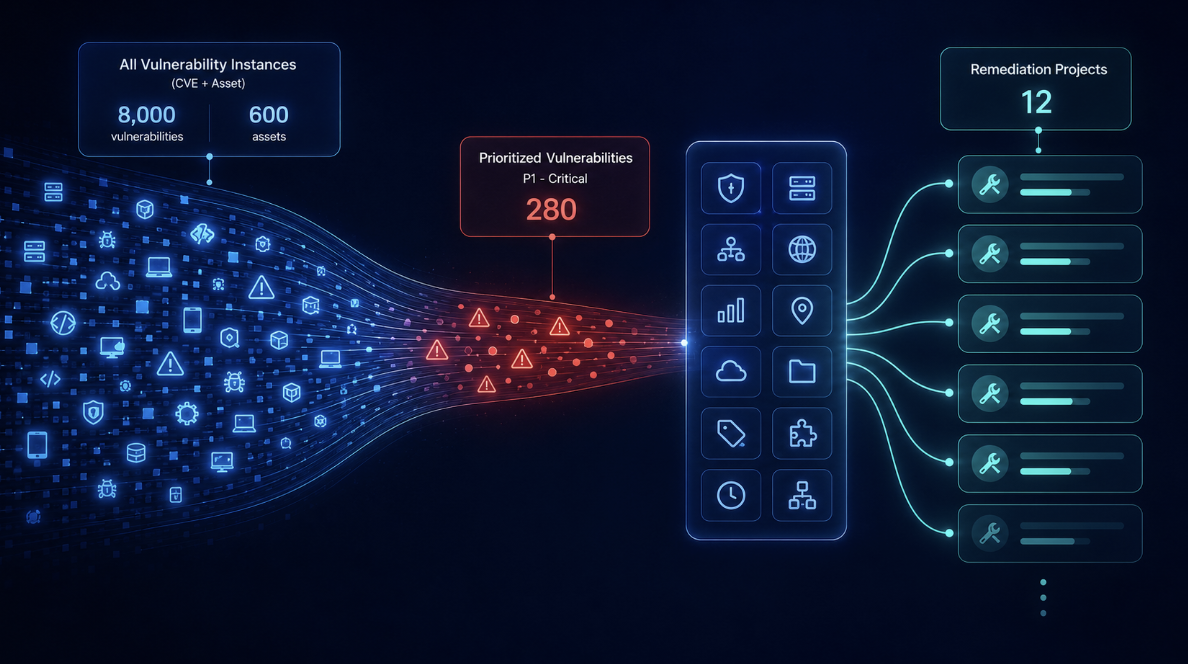
Each project must provide detailed insights into the flaws to be corrected, the impacted assets, and the specific mitigation or remediation measures recommended. By translating technical results into clear action plans, organisations ensure proper progress tracking until final resolution.
Phase 4: Remediation and Mitigation Execution
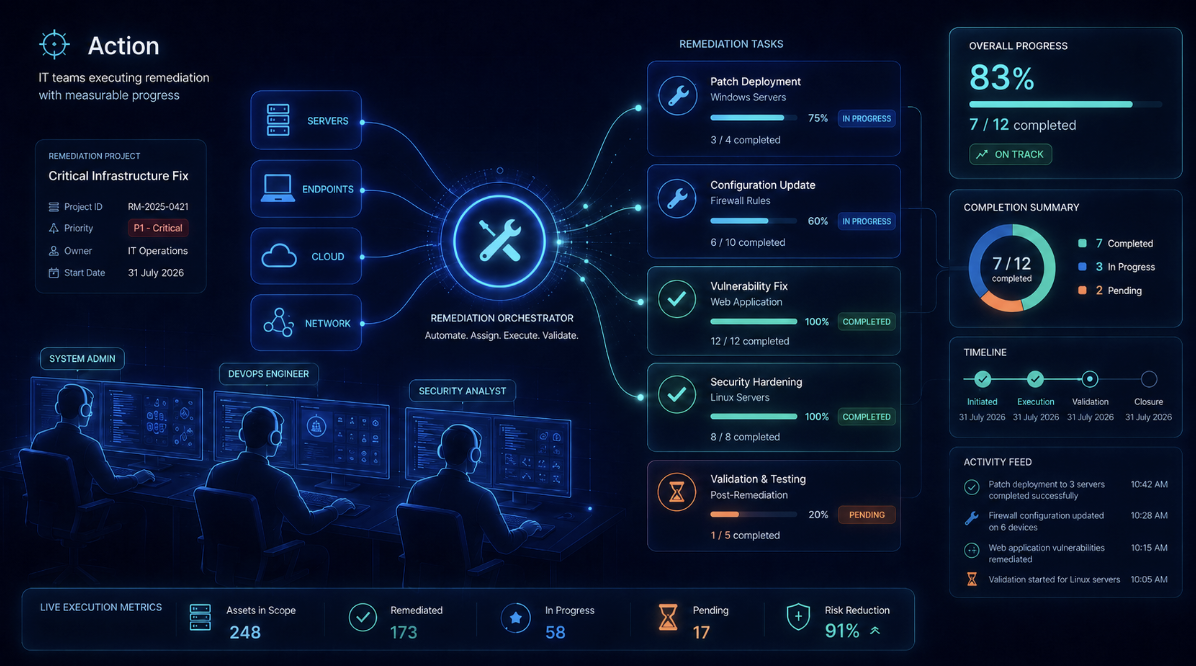
This is the execution phase, guided by clear instructions within defined action plans. IT and operations teams apply patches, modify configurations, or implement compensating controls to mitigate targeted risks efficiently.
Phase 5: Verification, Reassessment, and Proof of Reduction
Crucially, a vulnerability is never considered resolved simply because an alteration or patch has been implemented. Following remediation efforts, the affected assets must be systematically reassessed to confirm that the vulnerability has effectively ceased to be present. Only when the fix is technically validated can the remediation project be closed, demonstrating a true reduction in risk.
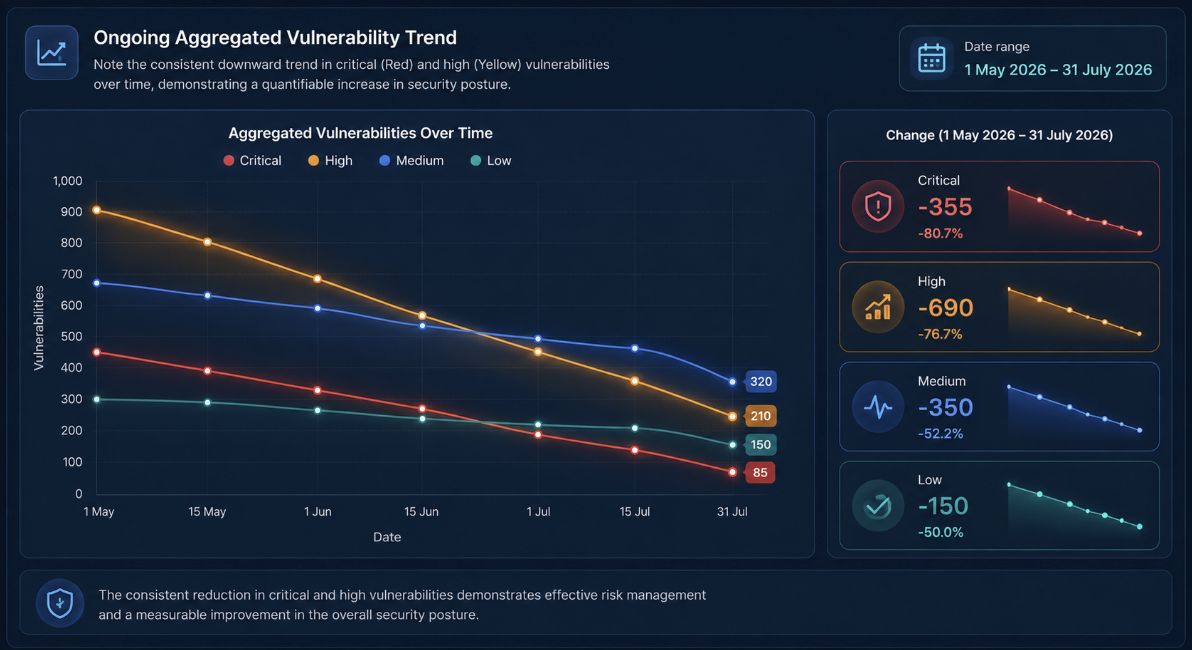
Delivering Ongoing Strategic Value The ultimate objective of Vulnerability Management is not just to identify more issues. It is to empower the organisation to utilise resources effectively, systematically reduce its exposure, and demonstrate continuous improvement of its security posture.
A well-executed program delivers continuous value across four fundamental pillars:
| Value Pillar | Executive/Operational Benefit |
|---|---|
| Visibility | A clear understanding of existing assets and current exposure levels. |
| Priority | The strategic intelligence needed to concentrate limited human and technical efforts on the highest-risk vulnerabilities first. |
| Action | Transforming raw detections into structured, actionable Remediation Projects. |
| Evidence | Rigorous verification of resolution and quantifiable evidence, via clear metrics, demonstrating the measurable evolution of the program and the reduction of organisational risk. |
Ultimately, Managed Vulnerability Management is not about simply identifying more issues. It is a strategic capability that empowers an organisation to use its resources more effectively, systematically reduce its threat surface, and provide verifiable evidence of a continuously strengthening security posture.
Bridging the Gap: How We Turn Strategy into Reality
At our core, we believe that navigating the complexities of cybersecurity requires more than just automated scanning tools; it demands a strategic partnership.
This philosophy is exactly what drives our Vulnerability Management Service. We take the burden of detection fatigue off your internal teams by executing this exact five-phase cycle on your behalf.
Every month, we handle comprehensive asset discovery, apply advanced risk-based prioritization to cut through the noise, and hand your IT teams clear, actionable Remediation Projects. Finally, we conduct the rigorous reassessments required to validate fixes, providing you with executive-level evidence that your organisation’s security posture is continuously improving.
We do not just hand you a list of problems: we partner with you to deliver measurable risk reduction.
Author : Eduardo Andrade